Are you ready to finally understand Nietzsche?
Beyond Good & Evil provides the ideal starting point for understanding Nietzsche's thought.It is among the most comprehensive of Nietzsche's works, and touches on every major theme of his philosophy: nihilism, morality, religion, truth, history, psychology, value, art, and much more.If you are tired of trying and failing to "get through" Nietzsche on your own, or are looking for an initial entryway into his philosophy that isn't just a Youtube video, then you are in the right place.Join my paid subscribers on April 18th, if you want to study Nietzsche's masterpiece Beyond Good And Evil with me.Participants will have access to live discussions of the text, recordings, detailed notes, and other helpful resources so that you can not just "read" Nietzsche, but understand his thinking.
Introducing...
Nietzsche
Beyond Good & Evil:
A Beginner's Course

Begins April 18th
ONLY 25 Seats Left
Why Read Beyond Good And Evil In 2026?
Nietzsche is not a philosopher who gives us comforting answers, but problems we didn't realize we had.Problems that force us to learn how to think for ourselves.This is why his works have appeared so challenging to most people.They require that you actually think.He did not write for everyone.He wrote for individuals he called "free spirits".These are individuals who:1) Courageously question what others accept as truth.2) Dare to create their own beliefs and values.In this course, you will not just "read" Beyond Good & Evil but challenge yourself to live and think differently.By the end of the book, you will have a clear idea of where you stand in relation to Nietzsche's vision of the future of humanity.That is, whether you are someone who is merely reproducing old ideas and following the masses, or an individual who has the potential and courage to live freely and creatively.The title Beyond Good & Evil tells you everything you need to know about why it's worth reading in 2026.We live in a world where genuine thinking is threatened. Where everything and everyone is divided into simple categories of "good" and "evil". At the same time, old value systems are being challenged and crumbling before our eyes. Everyone feels a sense of instability and uncertainty.Nietzsche saw this coming.
He called it a crisis of "modernity".Nietzsche believed the solution was not better answers—but the production of better thinkers.Nietzsche believed that the future of humanity demanded that we learn how to think and live beyond the simplistic black and white moralizing of "good" versus "evil".We have seen the harmful effects of this way of thinking throughout human history and even into the 21st century.Nietzsche attacks the very idea of any strict opposition, not because he is immoral, but because a true understanding of morality requires more subtlety and nuance in our thinking than we have previously been able to achieve.This seminar is about reviving and strengthening your capacity to think for yourself.This is not a passive lecture series but a rigorous program of study designed to shape you as a person.Everyone I know who has truly digested Nietzsche's work has been changed in some fundamental way.You may be familiar with the feeling of reading, reacting, and trying to understand, but struggling to develop your own thoughts.They just circle hopelessly instead of advancing productively.You grasp the intellectual argument, but you cannot connect in an original, personal way. You know there's more to it, but you don't know how to get there.The aim of the course is to get you there.Throughout this course, you will find yourself unlocking new ways to reflect and engage with the world.Specifically, you'll learn how to:- Detect hidden assumptions in moral thinking- Understand the psychological roots of belief- See why most philosophy fails—and what replaces it- Begin constructing your own framework for truth, value, and actionIf you don’t question your values—you will live according to someone else’s.
Meet your instructor...
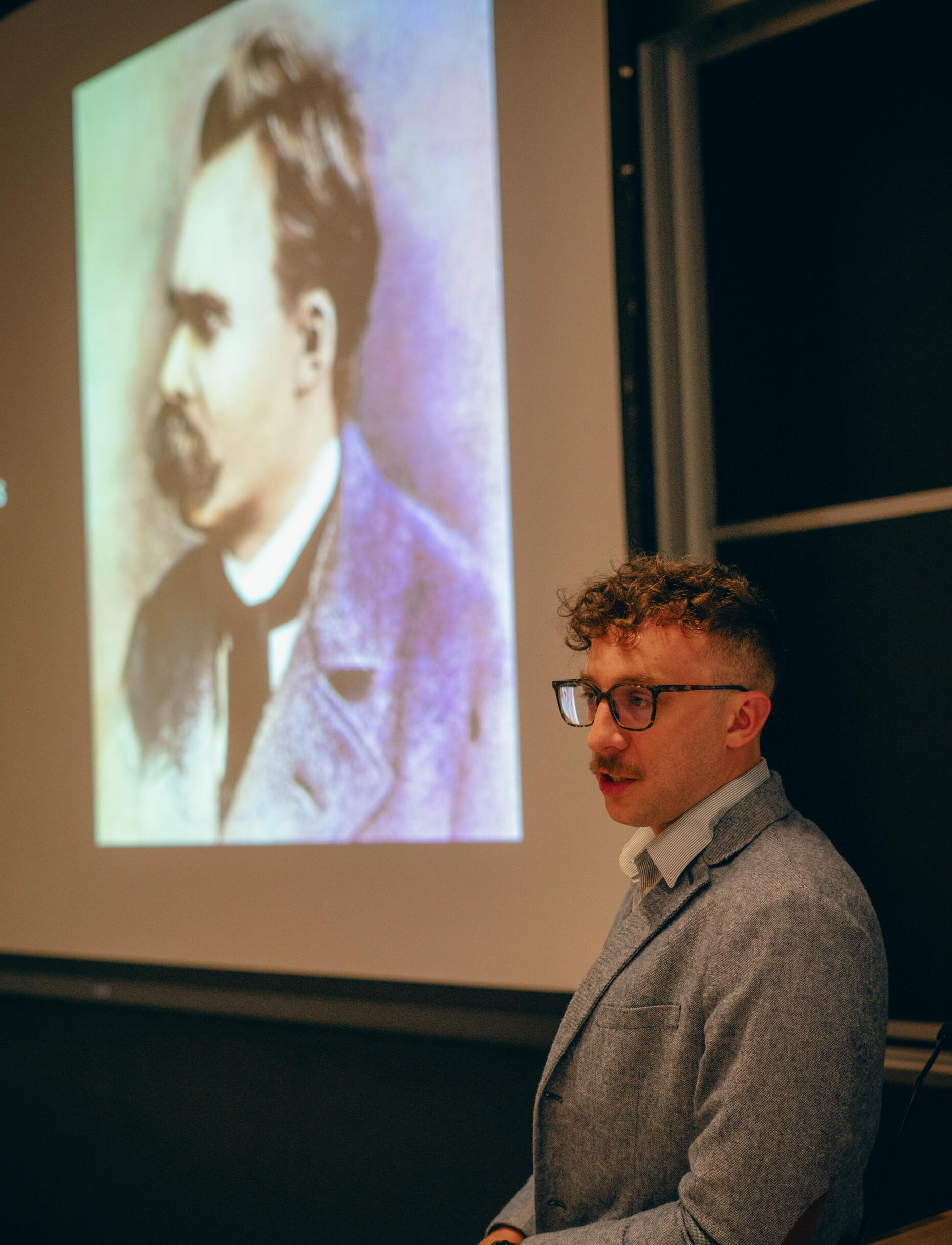
Paul Musso, PhD
I received my PhD in Philosophy from the University Of Pennsylvania in 2022.My primary research interests were the history of ethics and metaethics.Since then I have taught over 20 undergraduate courses at various universities.I have been reading and thinking about Nietzsche for over 15 years, and I would consider him my main philosophical influence and favorite philosopher.
Course Syllabus
This course will be a close reading of one of the major works of Nietzsche’s mature period:Beyond Good and Evil.We will discuss the major themes of his thought including: his conception of philosophy, philosophical method, his critique of morality, will to power, and his reflections on the nature of truth and knowledge.We will also consider Nietzsche's thought in relation to contemporary
philosophy and culture.Nietzsche is one of the most important and influential philosophers of our age, primarily because he is the most intransigent critic of modernity.The themes addressed in Beyond Good & Evil are more pressing than ever.
Reading Schedule
Week 1: Introduction To BGE and Nietzsche
Week 2: "On the Prejudices of Philosophers" (I)
Week 3: "On the Prejudices of Philosophers" (II)
Week 4: "The Free Spirit"
Week 5: "The Religious Mood"
Week 6: "The Natural History of Morals"
Week 7: "We Scholars"
Week 8: "Our Virtues"
Week 9: "Peoples and Countries"
Week 10: "What is Noble?"
Course Requirements
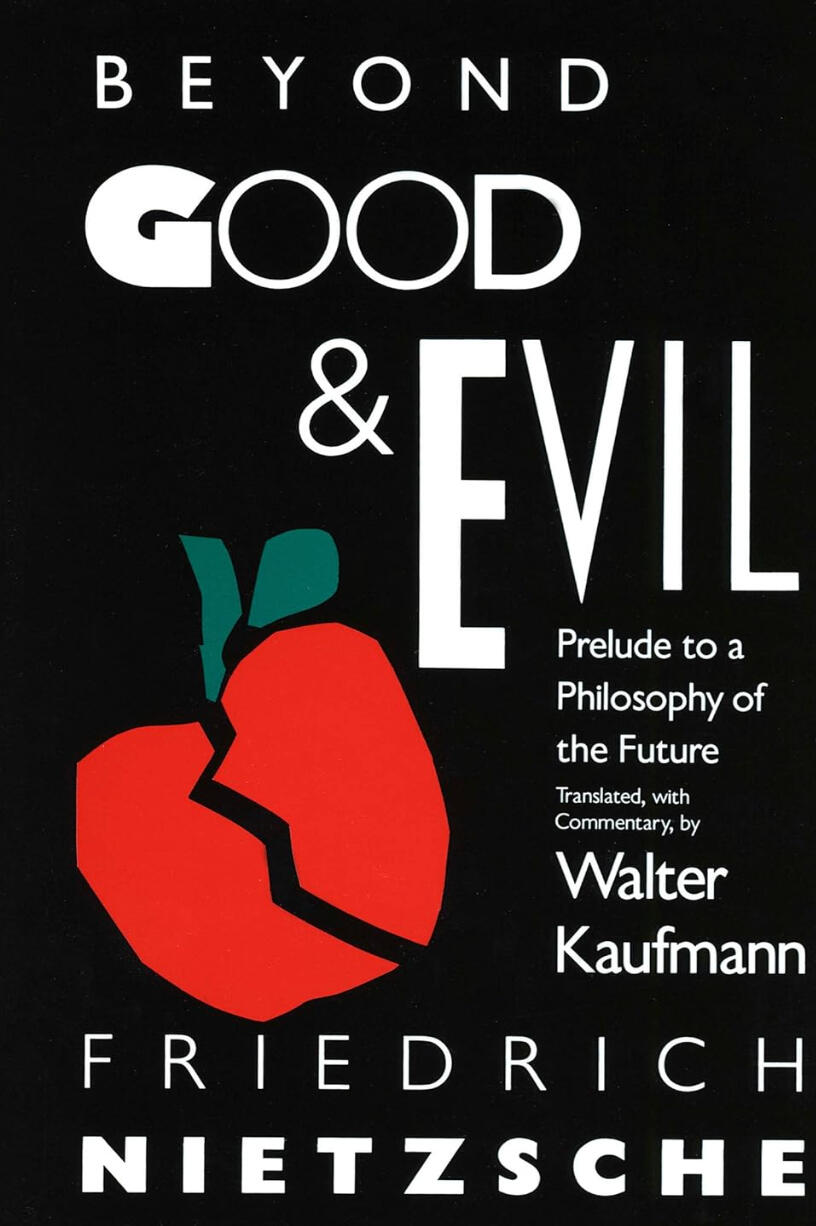
There are a few simple requirements for the course.First, if you want to participate in the live calls, you will need a stable internet connection and consistent availability on Saturdays at 12PM EST (New York).Second, you will need the right translation. We will be using the Walter Kaufmann translation of Beyond Good & Evil which can be purchased for $10 on Amazon. For some strange reason, it can be a bit tricky to find through Amazon search, so I recommend using Google and searching "Walter Kaufmann Beyond Good and Evil".This translation is required for the course. I strongly recommend buying a paperback version and not buying a kindle version or using an old translation. There are some free translations available online but they are terrible!
When You Join...
Anyone who enrolls in Beyond Good & Evil: A Beginner's Course will receive full-access to the following:
10x Live Group Calls: Intensive small group discussions of the text and broader philosophical themes
Class Recordings and Notes: Unlimited access to class recordings and searchable post-call notes
Weekly Reading Guides: Complete notes, instructional videos, and weekly advice to keep you on track
Nietzsche Resource Guide: Recommended books, documentaries, videos, and other helpful tips about what to avoid
Anyone who enrolls also receives the following bonuses:
The Micro-University Vault: Unlimited access to The Micro-University, which includes a growing library of other courses and helpful resources not available anywhere on the internet.
Heidegger's Being and Time: A Beginner's Course: A complete course on Heidegger's Being and Time that is currently ongoing.
The Micro-Reading System: My complete guide for reading non-fiction and philosophy in particular. This guide will "teach you how to read like a professor" from the ground up.
More About Beyond Good & Evil
Beyond Good & Evil is the book that Nietzsche wrote after his self-proclaimed magnum opus, Thus Spake Zarathustra. He writes:"With [Thus Spoke Zarathustra] I have given mankind the greatest present that has ever been made to it so far. This book, with a voice bridging centuries, is not only the highest book there is, the book that is truly characterized by the air of the heights—the whole fact of man lies beneath it at a tremendous distance—it is also the deepest, born out of the innermost wealth of truth, an inexhaustible well to which no pail descends without coming up again filled with gold and goodness" (Ecce Homo, "Preface", Section IV).Unfortunately, Nietzsche's gift to mankind fell flat because, in his opinion, very few were ready to receive his message. Nietzsche suspected that this might be the case, which is why he subtitled his work "A Book For All And None" (a philosopher of the future should not expect to be well received in the present).But Nietzsche's message has lived on...Beyond Good & Evil serves as a kind of philosophical restatement of Nietzsche's biggest and boldest ideas about the history of philosophy, the future of philosophy, religion, morality, human psychology, and nihilism.While his earlier work, Thus Spoke Zarathustra, presents his ideas in a poetic and symbolic form, Beyond Good and Evil delivers them with precision, clarity, and force.This is Nietzsche at his most philosophical—and his most dangerous.It is a work in which we see Nietzsche in full attack mode, aiming to dismantle the prejudices of the past in order to clear the way for the future of philosophy.Nietzsche himself calls Beyond Good & Evil a “critique of modernity.”In the work, Nietzsche accuses past philosophers of lacking critical sense and blindly accepting dogmatic premises in their consideration of morality. More specifically, he accuses them of founding grand metaphysical systems upon the faith that the good man is the opposite of the evil man.The work moves into the realm "beyond good and evil" in the sense of leaving behind the traditional morality which Nietzsche subjects to a destructive critique in favor of what he regards as an affirmative approach that fearlessly confronts the perspectival nature of knowledge and the perilous condition of the modern individual.He opposes liberalism, socialism, and conservatism; religion (especially “progressive” religion) and “thoughtless” atheism; modern science (for not being scientific enough); utilitarianism; hedonism; and most philosophy as it has heretofore been practiced.Of the four "late-period" writings of Nietzsche, Beyond Good and Evil most closely resembles the aphoristic style of his middle period.In it he exposes the deficiencies of those usually called "philosophers" and identifies the qualities of the "new philosophers": imagination, self-assertion, danger, originality, and the "creation of values".He then contests some of the key presuppositions of the old philosophic tradition like "self-consciousness", "knowledge", "truth", and "free will", explaining them as inventions of the moral consciousness.In their place, he offers the "will to power" as an explanation of all behavior; this ties into his "perspective of life", which he regards as "beyond good and evil", denying a universal morality for all human beings. Religion and the master and slave moralities feature prominently as Nietzsche re-evaluates deeply held humanistic beliefs, portraying even domination, appropriation and injury to the weak as not universally objectionable.Despite his famous talent for critique, Nietzsche was not a negative philosopher.He was in favor of building a philosophy for the future that broke free from the dogmas of the past and allowed for the human spirit to flourish.
Nietzsche believed that it is only when we move “beyond” traditional philosophy and morality that can we become “free spirits” and create
new philosophies, new moralities, and new works of art that "ennoble" humanity (make us noble).The measure of a belief system is, for Nietzsche, not its "truth", but its ability to produce a robust, demanding, fulfilling (and unique) way of life, for an entire people or society, not just for one individual. (This last point is routinely missed in all “summaries” of Nietzsche’s thought.)
FAQ
Am I Qualified To Take This Course?
If anything on this page resonated with you, you're qualified to take the course and in the right place.
Do I Need To Have Already Read The Book?
No. Most participants will be encountering it for the first time. The course is designed to provide the historical context, intellectual framework, and personal support that makes a first reading extraordinary.
What If I Don't Have The Book Yet?
You don't need the book for Week 1 since that is just an introduction. We won't start reading the actual text until Week 2.
Which Translation Do I Need?
The correct translation of Nietzsche is crucial. We will be using Walter Kaufmann's well-respected translation.
How Much Time Do I Need To Set Aside Each Week?
It should take you 45-80 minutes to read each week's material. There is also a 60-80 minute live class every week. Therefore, you should plan to spend 2-3 hours per week on the course until we finish the book.This is a serious personal and intellectual commitment, which is part of the point.
What If I Can't Make The Live Calls?
There will be recordings of the live sessions. I would also be happy to meet with you individually if possible to discuss the missed material.
I'm Not An Academic -- Will I Be Out Of My Depth?
No. The seminar is designed for a non-academic, but intellectually serious audience.
How Much Does The Course Cost?
Access to the course is through a subscription to The Micro-University, which is $80/month (and also gives you access to all other courses and resources offered, including the course on Heidegger).
What If I Can't Afford It?
If the full price of the course is too much right now, or if you don't expect to be able to make the live calls, reach out to me directly and I will try to work with your circumstances.
What If I Fall Behind On The Reading?
You will have all of the guides, notes, and tips you need to catch up, or learn at your own pace if you fall behind. I encourage you to attend the live calls even if you didn't finish a particular reading for the week.
Can I Participate From Outside The US?
Yes. The seminars are live on Google Meet at 12PM EST (New York) which acommodates most time-zones.